710-Axis lock instability issues

I have a current 710-Axis (M4) and it has an issue with lock instability.
Specifically if the pivot gets loose it is very trivial for the lock to release under loads on the spine.
It happened when doing heavy cutting and after that I verified it was spine loads causing it by simple light impacts on the spine which would cause the lock to release.
Is this the expected behavior of the lock?
Specifically if the pivot gets loose it is very trivial for the lock to release under loads on the spine.
It happened when doing heavy cutting and after that I verified it was spine loads causing it by simple light impacts on the spine which would cause the lock to release.
Is this the expected behavior of the lock?
0
-

As a short answer, and to abuse the language a bit, the same telling has been told from customer service and the members here, failure of the lock is not normal, spine whacks shouldn't disengage the lock.
I'll argue all day long that spine pressure is something that locks should defeat, not that it's the primary purpose of the lock, but especially in the axis lock, not something that should be an issue.
What the video doesn't show is the manner in which the lock was defeated.
The best option for the knife is to send it to the factory, both for your safety and the integrity of the knife as you expressed that you are going to continue using it.0 -
quote:Originally posted by Skimo:
I'll argue all day long that spine pressure is something that locks should defeat, not that it's the primary purpose of the lock, but especially in the axis lock, not something that should be an issue.
The issue mainly comes down to level of force which is why makers/manufacturers tend to avoid the topic. Cold Steel aggressively promotes spine impacts, they are about the only one that does it though.
The problem is that you as a maker/manufacturer say spine loads should not collapse the lock and then someone hits the spine with a hammer to cut a 3.5" nail in half and then complains that you said the lock would hold.
As the impact mechanics are affected by both dead load and even speed of impact it isn't trivial to say a blanket yes/no. It is similar with prying which is why most will just make a vague comment about materials defects and that things have to be case-by-case evaluated which isn't that unreasonable.quote:
What the video doesn't show is the manner in which the lock was defeated.
Yes, that would not be expected because :
a) I don't video tape all the work I do
b) The cutting is highly random and thus you would need to do it for some time to cause a disengagement, hence the direct experiment.
It came unlocked cutting out the sods seen in the first part of the video, eight sods were cut to allow the placement of the walk-way stones, 50-70 slices per sod. The lock collapsed on one of the later ones when I didn't tighten the pivot immediately as I wanted to see how much effect it made in cutting with the loose pivot (nothing significant).
As a side note, I used a bunch of knives the 710 was only one, I was doing a simple check on high vs low carbide steels in very demanding situations and also looking at rate of abrasion (sharpening time) on two different stones.quote:
The best option for the knife is to send it to the factory, both for your safety and the integrity of the knife as you expressed that you are going to continue using it.
To be frank, the knife is an inanimate object, I have little interest in what is best for it. It is not practical at all for me to return it to Benchmade for reasons noted.
I do intend to take it apart and compare it to the RSK when I get that back from being on an extended passaround (7'th year I believe of it) and if I can't resolve the issue with the pivot then I will likely put a thread locker on it and then over load the lock to see how/where it fails.0 -
 quote:Originally posted by Cliff Stamp:
...if I can't resolve the issue with the pivot then I will likely put a thread locker on it and then over load the lock to see how/where it fails.
You can save yourself the trouble and a decent knife. Check this videos out:
http://benchmadeforum.com/eve/...08001/m/8530052980010 -
quote:Originally posted by Po:
You can save yourself the trouble and a decent knife.
I am an experimental physicist, it is no more trouble to me than breathing.
I have seen those video's, I was around during the lock wars of the early 2000's and the race to the 1000 in.lbs lock.
The problem with those tests then which still exists now is :
a) They don't examine lateral loading which tends to be the functional weak point.
A slow spine load doesn't replicate any normal or even abnormal use of the knife. To see this in use you would have to be prying vertically which is exceedingly rare and would mean the edge is directly in contact with something which could resist the compression stress which is basically rock or hardened metal. I don't doubt that someone somewhere has done this, but it is a very odd use to design your testing around.
b) Vertical failures come through impact which is a fast/dynamic load which usually causes the lock to fail either by one-shot direct over load or repeated much lower shifts/bounces or onset of damage which allows the former.
I made the argument then when these tests first started to be promoted, which I would still make now, is that what would be actually useful :
a) vertical impacts (not slow loads)
This is critical because most people complain about releases not breaks.
b) lateral slow loads
This of course is how almost all prying is done and you need to know what is going to fail the blade, pivot or lock.
For both of these, you need to check the 100% break point and also the yield point which is the point at which if continued will lead to rapid onset of early failure.
However both of these tests will generate far less impressive numbers than the slow vertical loads. For example about 50 ft.lbs of energy of impact even with a soft striking surface (wood) can produce rapid failure even in high end locks, but the same dead weight does nothing, even when it is 10X as high.0 -

While I appreciate the theoretical it seems a long way, 4 pages, to arrive at the decided action of disassemble, inspect, reassemble w/ a drop of loc-tight..test, evaluate.
It seems the concern is of a particular knife under specific tasks. Unless this is a design debate. I guess I dont understand the initial apprehension to do so when shipping the knife back to BM was determined to be a no go. I heard once that a man needs to understands his limitations, this means knowing the limits on his gear/equipt as well I would think.
If the knife seems sketchy to trust for that particular task...use a different one, a fixed blade maybe. If this is that a knife of this price point shouldnt behave like this, well...seems like a different debate. Its an imperfect world. a folding knife is a mechanical thing,...screws/bolts back out all the time..there are solutions. I understand the loosening of the pivot has little or no effect on the disengagement but...why not set it if not to eliminate that as an issue. If its a design debate..again, different .
Truly not trying to be a smartass. This particular seems to be over thunk, dont you think? Again, unless I misunderstand this to be concerning a specific knife...and not a design, R&D issue and or case study of the Axis..Im having trouble with the prolonged decisive action.0 -
quote:Originally posted by Patrick:
While I appreciate the theoretical it seems a long way, 4 pages, to arrive at the decided action of disassemble, inspect, reassemble w/ a drop of loc-tight..test, evaluate.
As noted, I don't consider a thread locker a functional solution. The initial post didn't ask as to the solution to the issue as I already had a number of practical solutions. The purpose of the post was to confirm if what was seen was the expected behavior.0 -
a) oh
2) Is a failed locking mech expected behavior? No
Charlie) A thread locker is not a practical solution to a loosening thread? Seems to be the most practical under the circunstance.
x) What would seem a practical solution? To somehow re engineer, w/ instructions, material list and required tools be sent to you as to not inconvenience or risk your blade to post service/customs....Seems impractical.
M2) you seem like a smart guy...but Im going to have to disagree...this seems like waaay more trouble than breathing.
M4) I view none of my blades as inanimate objects...they all have souls.
M390) Maybe thats what happened in your case...you pissed it off somehow and now it wont perform for you.
In conclusion:
Talk to you knife, let it know you love it.0 -

Patrick, LOL.  0
0 -
 0
0 -
quote:Originally posted by Patrick:
x) What would seem a practical solution?
If I wanted the knife replaced, and it was defective then I would simply talk to the person I purchased it from as they would replace the defective product directly. If it isn't defective and it is the expected behavior then the solution is simply to find a useful purpose for it given the nature of its behavior. The most likely outcome/solution was noted in the above.
After some further investigation it seems that the more detailed cause of the problem is not simply a sudden load, but repeated loads. I have verified this by :
-taking the knife, loosening the pivot, subjecting it to spine loads, and after each load to unlock and then lock the knife
This does not cause the lock to release. However if this is slightly modified :
-taking the knife, loosening the pivot, subjecting it to multiple spine loads in succession
The lock will release on average between 3-5 hits. There is a bit of a spread but most often it is in that range. It appears that what is happening is that the blade tang is actually bumping the axis bar up (only slightly) and when it comes down the blade is rotated slightly up so the bar sits back further. If this is repeated in succession the bar is basically bumped along the blade tang until it releases.
It was also pointed out that the pivot screw on the 710 also serves as the main forward point on the handle which holds it together and thus as the pivot gets loose so does the handle itself and any sway in the handle will make that noted movement more possible/likely.0 -
quote:Originally posted by Patrick:
Um,.. There definitely seems to be an instability issue here.
Stop repeatably whacking your spine. Cant be healthy for you or your knife. Seems alot your asking from any folder. The Axis design is sound for its intended purpose. Get some thread locker and a fixed blade. Proper tool for proper task.
Patrick,
As noted previously, the lock disengaged during routine cutting. The spine loads were necessary to understand why it happened and through them it has become obvious that it is indeed a high speed spine load which is causing the problem, and more specifically that it is repeated loads without allowing the lock to reset.
Now of course the impacts were not the only thing done to examine why the lock failed, it was also subjected to various other loads including lateral and slow loads on the edge and on the spine, but none of those caused any issues in the simulations.
I have already noted why thread lockers are not a practical solution, and nor are fixed blades. In general recommending a fixed blade for a folder problem has little utility because if you can carry a fixed blade then it is always a better solution. Folding knives only have one benefit, they can be practical to carry when fixed blades are not.0 -
quote:Originally posted by Cliff Stamp:
...If I wanted the knife replaced, and it was defective then I would simply talk to the person I purchased it from as they would replace the defective product directly. If it isn't defective and it is the expected behavior...
So, vis-a-vis the feedback from this forum, have you made a determination?
Patrick -
Spine impact "testing" - seems like a overly dignified term for violently abusing your folding knife, which is why I named it the "Spine Whack" Test those many years ago - has a meaningful heritage. It was how the consumer group informally known as knife nuts determined that the Axis lock was in fact vastly superior to liner locks, and that the "Walker" liner lock was an inherently unreliable mechanism.
In the late 1990s, at the rise of the tactical folder revolution, I was watching a promotional video clip from a pre-emminent maker of "tactical folders", where the maker was armed with one of his knives, and he was facing an opponent wielding a baton of some kind. Being a practitioner of Filipino Martial Arts, that set my mind working, because if I were attacked by a knife wielding criminal, and I had a baton, my first target of attack would have been the knife hand. At the same time period, Joe Talmage had discovered that he could cause virtually every liner lock folder he possessed to fail by moderatly smacking the back of the knife on a bench top. It was a natural step for me to start taping my folding knives to sticks, and start whacking the spines with other sticks. Liner locks and frame locks failed this test almost unanimously, while I don't recall ever causing a dis-engagement of an Axis lock (the 710 had just come out).
So, for better or worse, the Spine Whack Test became the benchmark for "tactical" folder lock reliability. Believe me there were a lot of people who were pretty outraged by it, but the Axis lock passed, so there it was.0 -
 quote:Originally posted by Cliff Stamp:quote:Originally posted by sabu71:
Cliff, no offense, and not trying to cross sword here, but it sounds like you might have to send it in (and I understand the issues with overseas shipping/laws).
It simply isn't practical, I normally buy everything through resellers I know to avoid issues. I normally only return items if the maker/manufacturer wants to specifically inspect them because for me it is always more cost effective to simply buy replacements - hence the question is it to be expected.
When I do return items I have a fairly simply but detailed list of shipping instructions which gets followed about 50% of the time and the other 50% I get hit with items bounced, full import and brokerage charges and even seized items. It is possible to fight all of these but it would take more time that the item is worth.
Now as to why I rarely use thread lockers :
a) I don't support using them in general on knives because I have knives that don't need it, that I never use it and thus it is simply a matter of quality. At a certain price point I would consider it a defect if a knife was not functional without a thread locker, especially if it happens in literally a few minutes work.
b) I often loan knives to friends, family and in general want my knives to be very versatile. Having to resort to glueing fasteners in place isn't thus ideal, because they are not going to.
c) I never carry thread lockers on me at all times (though you can improvise semi-decent ones out of any very thin material)and having a knife which requires it is thus less than ideal because to maintain it requires special materials.
I do realize different people have different tolerances, but for me the main issue here is how fast the knife becomes loose and as a followup that it becomes unstable after that. Now if it took a week of carry, no issue. If I had to tighten it at the end of a day, a little annoying but still workable, but not every few minutes.
Nice knife though and nice to see the steel, I was one of the first to actively campaign for more HSS when they first started using M2. Though then, as now, I would prefer a slimmer edge profile given the nature of the steel. In its current configuration it would be simpler to use D series steels as they also have very high wear and would be stable in the edge thickness/angle that this one has (assuming it is representative).
Fair enough (I think it's a bit out there, but whatever floats your boat)
Oh, and thanks for the compliment. I did my homework back in the day (I might have come across a few of your writeups back then (and also the gent named Zvis and his extensive testing). I had a few BM's already (the 905 Mini Stryker, and the 942), and while they held up very well to my use, I was, like all knife knuts do, looking for an upgrade so far as performance goes (or in short, something I could use a good bit, and not have to screw around with much so far as sharpening goes). So I read, and read, and I found the 730CFHS, the ultimate so far as the ideal folder went. Nice grind on it, and loved the ergos. Did a lot of hunting for it, but could never find one (at that time anyhow), so I split the difference, and went with the more readily available (at that time) 710hssr. The first evening I brought it home, I opened up a case of beer with it. As I put the knife back in my pocket, I heard a hissing noise in the case, and sure as heck, I nicked one of the cans in the pack accidentally. I checked the edge for any problems. Not a damn one. Still mowed down hair on my forearm.
That's when I knew I found the right steel for me. And I've been a fan of M-2 ever since. It's still my gold standard that I compare steels to. Later on, I've added to that (finally found that 730CFHS in a local store, and I had to sell my soul to get that one...Steve might remember that thread LOL), added the 710HS, and also a 140HS to round things out (the 140 was an impulse buy. BM had started to bubble the tar on M-2, which I thought a bad desiscion. But that's when I learned about the business side of things. Would love if they brought it back, but I'm not holding my breath on that one).
But I've owned a bunch of knives with different steels (these days, I call it "Alphabet soup" with the infusion of all these carpenter steels that hit the market), and so far as I can tell, they're pretty good steels, but I always keep coming back to my M-2 blades when I've got a tough job to do (incidentally, the edge on my 710HS and 140HS is fairly thin...seemed to come that way anyhow. That is, comparing it to my 710hssr and my 730CFHS anyhow). The only steel that's come close to it for me has been CPM-M4. I tried that with a Spyderco Gayle Bradley folder that was another impulse buy. Was as good as advertised. Not M-2, but damn close. That holds a nice edge for a long long time...and I'll also go on record, one of the best made liner locks out there. No wobble, and it hasn't failed me yet).
But that got me thinking: Wonder how well serrations would hold up on M-4 ??? Well guess what ??? I haven't seen a Spydie with a serrated M-4 blade, like ever.....so when the Contego came out, I jumped on that in a hearbeat. I've kind of come full circle with blade configurations. I started out using combo edges, then started shifting towards plain edge, and around the time I got that Bradley folder, I started going back to combo edges). So since the ratio of plain/combo was what I was looking for in the Contego, I went with the combo edge. Needless to say, I've not had to sharpen the serrations yet with it yet, and I've used the serrations quite a bit (notably out in the yard, where the jungle I have has a lot of thick vegetation growing, and I use the serrations like a hand saw. It has not disapointed, needless to say. The serrations performed how I thought they would.).
So the Contego has become my favorite "yard knife" as of late. I do think the knife is kind of "jimp happy" as it were. I hasn't bothered my hands all that much to be honest. But in my mind, I don't think it needs all the jimping that it has on it. As such though, when I'm out in the yard like that, I usually have a pair of gloves on anyhow, and the Contego works very well with the gloves.
But I digress here, insofar as the high performance steels go, I always turn to my M-2 blades (I like my stainless blades too, don't misunderstand....as of late, one of the ones I've been impressed with is a Spyderco Paramilitary 2 that I got in the basic s30v config. For what I'm getting, I've not had to touch it up all that much, which to me is a testament to the edge geometry and heat treat of the blade. Which in my mind, is the basic fundementals for having a good edge retention that will last...not that the materials aren't important either. But if you combine all three, then you've got one hell of a blade).
So what am I carrying today ??? A Benchmade Skirmish (which for the steel, is in the same category as the aforementioned Paramillie 2....I don't have to do a whole lot to it, and it just cuts and cuts, and cuts like crazy. Had that one for a long time too, and it still locks up bank vault like, and hasn't failed me yet)0 -
This is like the good old days...nice long well written, well backed write-ups by Po & Sabu. The forum doesn't get much better than this.  0
0 -
quote:Originally posted by fastjan:
This is like the good old days...nice long well written, well backed write-ups by Po & Sabu. The forum doesn't get much better than this.
+1 Fjquote:Originally posted by sabu71:
...
so I split the difference, and went with the more readily available (at that time) 710hssr. The first evening I brought it home, I opened up a case of beer with it. As I put the knife back in my pocket, I heard a hissing noise in the case, and sure as heck, I nicked one of the cans in the pack accidentally.
And that beer was Budweiser, IIRC.So isn't that the King of Beers vs. what you call the King of Knives?0 -
I do understand the ¨Spine Whack¨ term and the value of the test. I also understand the inherent superiority of the Axis over other locking mechs. Indeed a large factor as to why I fly the BM flag and participate on this unique forum.
I did not understand the OPs history here and the sincerity of his plight. Given the intelligence along with his obvious understanding of mechanics and steel properties, it just seemed like a very long way to go, with perceived unreasonable stipulations, to arrive at certain conclusions. In short I guess I didnt buy it. I took it all as an off handed slight, passive aggressive style,towards the Axis mech. A ¨playing stupid¨ act if you will as to run fans and members around as kind of a private giggle. I posted in haste, filled it with sarcasm and then when back and re read the thread. Sincerity is there and his plight, while mostly internal, seems legit. Which is why I retracted my last post.
I am fairly new to the knife thing and many things Ive yet to understand. This situation seemed like an easy fix. I appreciate the scrutiny and testing, the ¨What if¨ scenarios. would in no way discourage it, this is what advances technologies. Ive dealt with engineers in the field whom could sometimes not understand what was on paper might have to be adjusted and or changed to be applicable and practical for real world situation. I think I felt some off that frustration here.
Apologies for any perceived slight on my part. Sincerely wish the resolve of the issue with your 710, and curios as to the outcome.0 -
 quote:Originally posted by fastjan:
This is like the good old days...nice long well written, well backed write-ups by Po & Sabu. The forum doesn't get much better than this.
Yea and then Sabu-Jon will start spewing some Pittsburgh Steelers' propaganda.
Some times the good old days were not that good.0 -
quote:Originally posted by Patrick:
In short I guess I didnt buy it. I took it all as an off handed slight, passive aggressive style,towards the Axis mech.
There is no issue with skepticism, it is fundamental to critical thought.
Calling me passive aggressive is however one of the funnier things I have heard in awhile.quote:Originally posted by Po:
So, vis-a-vis the feedback from this forum, have you made a determination?
It appears that there is a consensus that the pivot screw backing out isn't defective however it is split on what should happen to the lock with a loose pivot.
The big problem with spine whack testing is just the name, because people use it to imply/argue it is just a bunch of uneducated cavemen beating (whacking) the knives about in a random manner.
Now Steve's evaluations could be accurately described as beating on the knives, but it wasn't random and it was part of his martial arts training. Joe did very different, impact were faster but not as heavy.0 -
quote:Originally posted by Cliff Stamp:
...it is split on what should happen to the lock with a loose pivot...
Was there another person who said they experienced lock releases with a loose pivot?
I don't remember reading anything that would indicate anything other than what you have is a knife with a defect of some sort, other than the pivot screw loosening.
The logical conclusions are, yes it is expected for the pivot to loosen if you don't do something to prevent it, and no, the lock should not release when it does.
So what are you going to do, fix the problem or return it?0 -
quote:Originally posted by Po:
Was there another person who said they experienced lock releases with a loose pivot?
Earlier post :
"Basically, if the pivot is allowed to get loose and wobbly, then all bets are off as to how the lock will perform. It's like any other mechanism...if you loosen all the screws, it's not going to work correctly."quote:
So what are you going to do, fix the problem or return it?
I am going to compare it to the RSK, see if there is a obvious reason why this is becoming unstable, if it is then fix it to verify the solution.
As it is not functional without thread lockers it isn't a practical carry option so I am most likely going to :
a) regrind it to full zero and compare it to Spyderco's M4 (ease of sharpening, edge holding at high/low sharpness, ...)
b) break the lock under impacts and if possible side lateral loads0 -
quote:Originally posted by Po:quote:Originally posted by Cliff Stamp:
...it is split on what should happen to the lock with a loose pivot...
....
Was there another person who said they experienced lock releases with a loose pivot?
....
hmm, you guys may find this thread interesting. At issue is how spine-whacking (or in this case, batoning wood) ultimately has an effect on the axis-lock's performance. Or rather the resulting liner deformation has an effect on Axis-lock performance.
http://benchmadeforum.com/eve/...17001/m/8610093580010 -
As an update, the knife was reground : 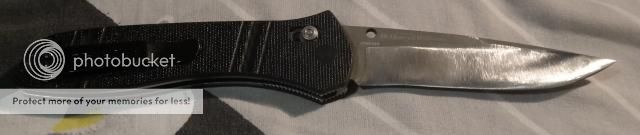
Here is has an edge which is :
-0.010"/10 dps
This isn't the final grind, I will thin it out further during the stock work, it will end up being very close to a zero grind with just a slightly curvature to the very edge which comes from the wear of benchstones.
Standard cardboard cutting :
Random samples of (mostly) 1/8" ridged cardboard cut into strips totaling 250 m :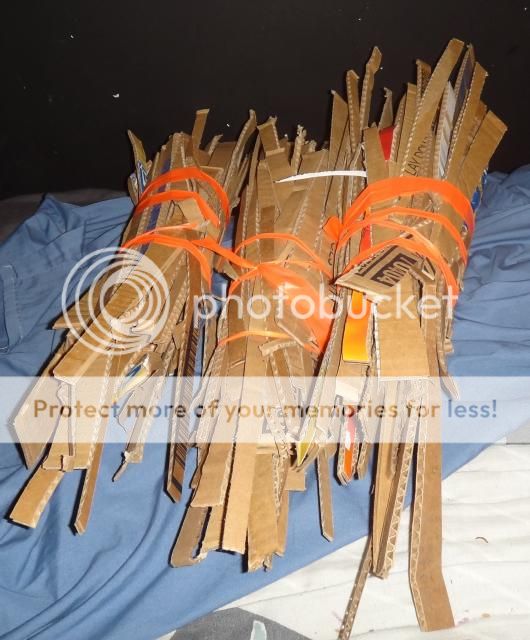
It does very well, among the best seen so far. Only one run is done, hence the values are not very precise :
http://www.cliffstamp.com/kniv...views/cardboard.html
But as expected the :
-high hardness
-high carbide volume (mainly small MC type)
which is aided by the ease of fine grained high martensite % in HSS should give very solid performance enabling high initial sharpness and good both early and late edge retention in media such as ropes and woods.0
Please sign in to leave a comment.
Comments
52 comments