Questions about 154cm Steel

I'm confused about the relative strengths and uses of the various steels BM uses for their knives. I'm figuring there's a ton of expertise here and someone can give me some guidance.
I was playing with my 520 Presidio and noticed that the blade is 154cm. Then I noticed that the 140/141, the 950 Rift and others that I associate with particularly hard, tough use often have the 154 rather than steels I think of as harder, tougher, and keeping a better edge -- M390, s30v, even D2.
What gives? I assume there are reasons for this but I don't know what they are. Can anyone help? I've read the blurb on BM's website about the different steels but would like to know more.
THANKS!
I was playing with my 520 Presidio and noticed that the blade is 154cm. Then I noticed that the 140/141, the 950 Rift and others that I associate with particularly hard, tough use often have the 154 rather than steels I think of as harder, tougher, and keeping a better edge -- M390, s30v, even D2.
What gives? I assume there are reasons for this but I don't know what they are. Can anyone help? I've read the blurb on BM's website about the different steels but would like to know more.
THANKS!
0
-

Ease of sharpening is the key Tucker.
I don't have an educated opine on M390 yet. S30V isn't that bad, but D2 is much harder to sharpen, particully 'out there' with often nothing more than a whetstone in the pocket. Yet they hold, like M390, an edge longer than 154CM does so there's a tradeoff.
I would much rather have a knife with 'softer' steel that takes an edge quickly.0 -
quote:Originally posted by joe_karp:
Ease of sharpening is the key Tucker.
I don't have an educated opine on M390 yet. S30V isn't that bad, but D2 is much harder to sharpen, particully 'out there' with often nothing more than a whetstone in the pocket. Yet they hold, like M390, an edge longer than 154CM does so there's a tradeoff.
I would much rather have a knife with 'softer' steel that takes an edge quickly.
Thanks, Joe! That was quick and I appreciate the distinction...easier to work, perhaps under "field" conditions verses stronger/tougher under ideal conditions. That makes sense.
Other insights? I'd like to get a handle on the distinctions between these steels.0 -

EZ to sharpen yeah, but also cheaper. The knife I carry the most for work is a satin 154CM 520 w/ lighter 522 scales. I've dropped it a few times, muddy it up often, hit wire, chipped it, mashed the tip-- no matter-- drop the tip a hair, sharpen it out. For some reason it doesn't bother me w/ this one as opposed to mistreating M4 or M390. And of course sharp, it cuts as well as the others. 0 -

There is a matrix of characteristics of the steels Benchmade has used, where each steel posesses varying levels of wear resistance, corrosion resistance, toughness, and cost. 154 CM actually may be the best overall steel of the group. S30V exceeds 154 in most categories, but costs more, same with D2, but some people think it is harder to sharpen, M4 is tougher and more wear resistant, but is not very corrosion resistant, M390 the highest performing stainless, but isn't available on every model, and is currently not available at all due to production problems.
So, bottom line, you can pay more to get a steel that is better in one or a couple of ways, but 154CM is very good at everything including cost. I have knives in all those steels, and where I like M-4 the best, I have never been disappointed in a Benchmade blade.0 -

Someone may know the history better than I do on this.
It is interesting that now 154cm is a very good steel, but the standard entry level for current BM's. A number of years ago (I don't know how long) 154cm was a "super steel" and AUS8, ATS-134, and VG10 were very good steels, and entry level for BM (still better than the steel in cheap $20 knives).
Today 154 is the entry level and there are new "super steels".
I love this web site: zknives.com Go to the "knife steel chart" There you can see the chemistry of each steel, and read about what each element does.0 -

154CM really is an ideal all-around steel for the majority of knife users. My Rift sharpens pretty easily yet keeps that edge for quite a while if I don't abuse it. I think CPM154 wqould be even better, but I don't know what kind of cost difference there is between the two. 0 -
Can you say a bit more about the difference between 154CM and CPM154? I just looked and all my "154" knives are 154CM -- a 940, a couple of Ares and my 520/525. Does BM use the CPM154, and can you give any examples?
Don't mean to be a pest, but "inquiring minds want to know!!!!" 0
0 -
The main difference is CPM-154 is crafted from powder metallurgy, giving it the advantage of much finer grain, meaning more tensile strength if heat treated correctly; and it will take a higher polish. Like the difference between ATS-34 and 154CM it's a minor, but noteworthy upgrade in quality. 0 -
^^^^ What he said.
Benchmade has never used CPM-154, and I doubt they will start now.0 -

I've never been fortunate enough to try a knife made of CPM 154. I did hear from a knife maker that I respect who thinks the CPM 154 version is significantly superior to 154 CM...not even close.
Offhand, I don't know why that would be, but I'm just passing along what I was told.0 -
quote:Originally posted by fastjan:
I've never been fortunate enough to try a knife made of CPM 154. I did hear from a knife maker that I respect who thinks the CPM 154 version is significantly superior to 154 CM...not even close.
Offhand, I don't know why that would be, but I'm just passing along what I was told.
Interesting. I wonder if the powder metallurgy process making a finer and more consistent grain structure plays into that. From what I've read, it didn't improve D2 all that much, but maybe it's different for 154cm.0 -
It's hard for me to compare D2 to CPM D2 just because the knives come from different manufacturers, so we are dealing with different heat-treatments and different grinds, but I like my CPM D2 lots better than my regular D2's. I know that's not very scientific, but I was told by a guy over in Colorado that I would feel that way and when I got the knife, he was right.quote:From what I've read, it didn't improve D2 all that much, but maybe it's different for 154cm.0 -

How does Benchmade's s30v compare do their 154cm? I like their 154cm, but have not had the chance to use their s30v yet. 0 -

I like their s30v a lot.
I find that the edges last longer without needing to be touched up, I can get a keener edge on it, and in my experience not noticably more difficult to sharpen than 154cm/ats-34.
I do believe that 154cm may be easier to sharpen in the field using ad hoc methods, but I have not been put in that situation that I would be able to say for sure.
In my books, the slight premium paid to get s30v is well worth it.0 -
quote:Originally posted by fastjan:
...I did hear from a knife maker that I respect who thinks the CPM 154 version is significantly superior to 154 CM...not even close...Offhand, I don't know why that would be, but I'm just passing along what I was told.
That would be my opinion also. Tom Mayo has been using CPM154 since its intro, and I am very impressed by it. It has that CPM grain structure, which means a much finer and more homogeneous grain structure than 154CM. The resulting performance enhancements are pretty well known for CPM steels now, a finer edge, tougher, more wear resistant, and more corrosion resistant. CPM 154 also does not suffer from the density issue that S30V has, which resulted in low deformation (dent) resistance, and maybe to that weird wire edge issue we are so familiar with. Those issues with S30V are why I tend to like D2 better when ultimate corrosion resistance is not the goal.0 -

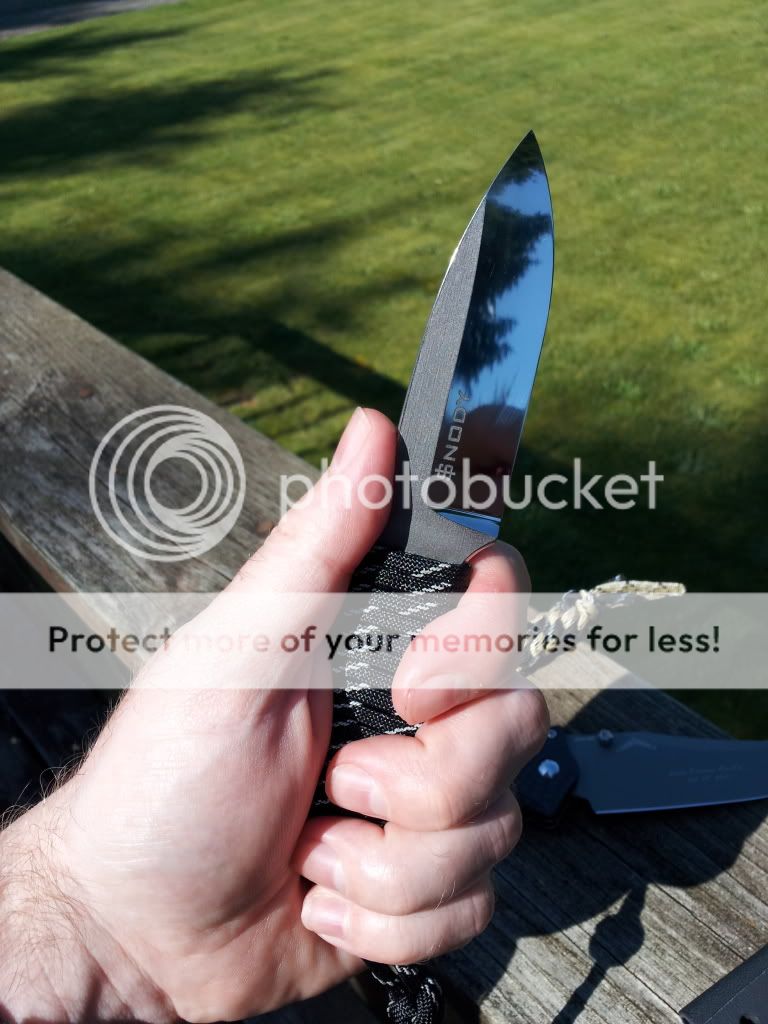
The only thing I have in CPM154 is my Snody Black Diamond Boss. The most use it's seen is shaving arm hair, but it does polish up nice and shiny. Like a mirror. 
 0
0 -
quote:Originally posted by Pasta:
The only thing I have in CPM154 is my Snody Black Diamond Boss. The most use it's seen is shaving arm hair, but it does polish up nice and shiny. Like a mirror.
If that weren't a chisel grind, I'd be all over that.0 -
 quote:Originally posted by Pasta:
The only thing I have in CPM154 is my Snody Black Diamond Boss. The most use it's seen is shaving arm hair, but it does polish up nice and shiny. Like a mirror.
Pasta,is it some kind diamond coating?0 -

Here is a great link to info about knife steels. It is written by Bladesmith Joe Talmadge, a true knife guru.
http://zknives.com/knives/arti.../knifesteelfaq.shtml
There are many characteristics that go into a good knife. For me the feel of the handle and the precision of the blade style is more important than the type of steel used in the blade. If you buy from reputable knife makers like BM you can be sure the steels they use are the best for cutlery.0 -

I thought 154CM and ATS-34 are similar?
The only difference is that one is American made and the other Japanese made.0 -
An issue of QC forced BKC to use ATS-34 instead of 154CM early on, I can't tell the difference, both are great blade steels. 0 -
If I remember right, in the late '80s, there was some quality problems with 154CM, lots of imbedded crud particles (leads? Not sure what the metalurgical term is...) in the stock, so most manufacturers switched to Jap ATS-34?
Anyway, around 2000 or so, those problems were corrected and Benchmade switched back. I can tell a big difference between the ATS-34 blades and the new 154CM blades myself. The new 154CM is definately finer grained. It was next to impossible to get a polished edge on those ATS blades. They would get just so sharp and no more. They weren't very tough either, but great edge holding. Put a medium edge on them and they cut like crazy for a long time.0 -
quote:Originally posted by joe_karp:
... I can't tell the difference ...
There is effectively no difference between the two, except who makes it.
A guy would need a full blown lab to find any differences between the two steels...
Any difference we would see as users would be due to differences in heat treatments.0 -
quote:Originally posted by Lightning:
...Any difference we would see as users would be due to differences in heat treatments.
Considering that the two steels have very similar compositions, I would assume that they would have very similar heat treat specs. But it is possible that Benchmade's heat treat changed over time. That could account for some differences in grain structure.
I have a couple of big bowie blades made from ATS-34. They are some of my favorite knives. They were made by a maker who used the lower duplex tempering temperature in the heat treatment. The maker claimed that this resulted in a more uniform grain structure, and his blades were extraordinary in terms of toughness for stainless steel. I've used them hard for a long time, and they are excellent. So heat treatment can make a big difference in the character of the steel.
All I can say is, having used and sharpened both quite a bit, my perception is that I can get a finer edge on the newer 154CM Benchmade blades than I could on the old ATS-34 Benchmade blades, and I think the 154CM edges are tougher too. You never hear anyone complain about edges chipping any more, and that was a constant complaint about ATS-34.0 -
I suspect that BMKs heat treats have gotten better over time.
I am sure back in the day there was a guy standing by the oven watching the thermometer and making adjust by hands until the timer went off. Then he would put on a thick set of gloves, take the knives out of the oven with a set of tongs and would then dunk in the quenching bath.
Now the oven will be computer controlled right down to the tenth of a degree, and once the PLC timer determined the precise millisecond to take the heat off, at which point the robot would move the blades to the quench at the exact right time.
The automated systems in place now have allowed companys to tweak heat treats to such a fine degree it is bloody amazing. 15 years ago, heat treat process were a trial and error process. Now it is a pure science.
I am positive this is the reason the 154CM of today performs better than the same steel of 10 or 15 years ago - simply better heat treatment.0 -
Hahahahaha! Agreed, there certainly have been improvements over the last almost twenty years(twenty years, can you believe that?) since Benchmade was using ATS-34. But even then, the professionals in the business were hardly blacksmiths. I remember taking blades that I had made to Pacific Heat Treating, which was doing heat treating for most of the local knife makers because they were knife enthusiasts, in the 1990s, and being amazed at their facility. These are the sort of businesses that have been doing heat treatment for Benchmade over the years. Perhaps Benchmade does their heat treatment in house now, I don't know, but I know ten years ago, they were jobbing it out to local professionals.
http://www.pacificheattreating.com/0 -
yup, big changes in the industry over the past few years.
Even the ovens available to small volume end users/makers have had drastic improvements.
15-20 years ago a guy could barely find an oven with a digital temp settings for less than 3 arms, a leg, and his left nut. Now fully computer controlled and programmable ovens can be had most anywhere for relatively cheap.
That is one thing I remember from back in the day; some of the most respected knife makers were the ones who could consistantly produce a good heat treat on their blades. It was more art than science.
And now most anyone can produce high quality and consistant HTs with just a little bit of time and practice.0
Please sign in to leave a comment.
Comments
27 comments