Oh no Omega

Well my first omega spring broke last night on one of my first Benchmades so it was only, what, two years old. Definitely not abused or even used much other than fidgeting and flicking it a lot. I was a bit shocked. Now I'm concerned that flicking open axis locks has a limited life span. Or maybe it's just a bad spring. Regardless, I am buying some replacement springs from amazon that say they are "appropriately heat treated" as I really don't want to wait for the time it takes to send in to Benchmade and, besides, this is the knife that I sort of messed up sharpening initially on a KME sharpening system but have since done much better on a Ken Onion Elite and it's pretty much my daily carry. It doesn't see heavy use maybe opening an occasional box.
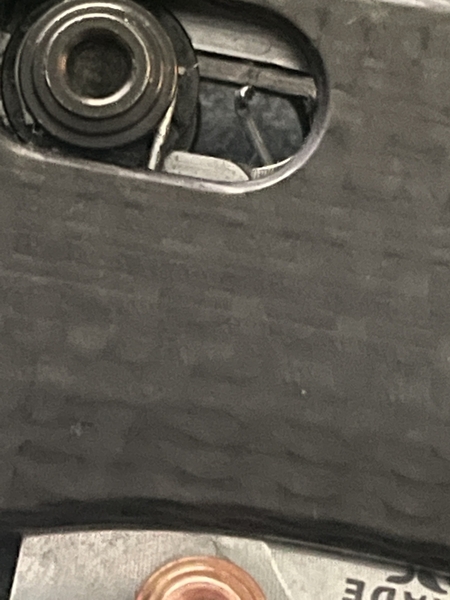
The replacement springs should arrive tomorrow so I'll see how it goes. I haven't taken it apart yet to verify the spring is actually broken, I did take some tweezers and try and pull it out enough so i could see the rest of the spring and it didn't look broken, but the picture below sure tells me it must be. It will not stay in the notch its supposed to on the frame.
I hope this is not normal as I do enjoy flicking benchmades. And yes I do use both lugs of the axis lock to release the blade, I never use just one side.
-

When you take the knife apart look to see if the Omega spring(s) have any flat wear spots in them. That's an indication that it or they have been rubbing on the scales. Flat spots reduce the strength of the spring and it will eventually break.
When you install your replacement spring(s) make sure that they are not bowed outward. If they are simply grab the spring by the hook side that goes around the axis bar and give it a twist in the opposite direction of the scale. It's preferable to have the spring riding slightly above the liner. Metal to metal does not cause the wear that metal to G10, Micarta or Noryl does. 9 out of 10 broken Omega springs I've seen had broken because of this type of wear. It's actually pretty rare to get a defective Omega spring that has a weak spot in it.
Hope this helps!
2 -

/|\ Never have had a broken omega spring. I’ve purchased some as backup in case one does break.
I’ve read on this forum in the past that axis lock functions safely with just one omega spring.
I don’t flip my knives open as I think it stresses the parts. ( fyi don’t go to a custom knife show & flip open a custom knife the makers get pissed, after you buy it they won’t care)
Tim, your observation that an omega spring leaning against a G10 / micarta scales will wear the spring out more than leaning against the steel liners is interesting. Maybe the steel omega spring against the smooth steel liner with a little blue Lube slides with little or no friction. Whereas the steel omega spring digs into the scales & doesn’t slide causing the wear. Tim, any sign of wear on the scales caused by the spring rubbing against it you’ve observed?
1 -
Bill you might notice some blackening on the scales depending on their color. Beyond that I've never noticed any actual wear on the scales.
I should add that I also have never experienced a broken Omega spring on any of my knives although I have replaced them for friends and other collectors. There were also some that had failed in a few of the Benchmade Facebook groups that the flattening was seen and the break occurred at or about the center of the flattening where the wear was the greatest.
0 -

Wouldn't the wear issue need to be resolved?
0 -
[@mention:589880809437764246] posted:
When you take the knife apart look to see if the Omega spring(s) have any flat wear spots in them. That's an indication that it or they have been rubbing on the scales. Flat spots reduce the strength of the spring and it will eventually break.
When you install your replacement spring(s) make sure that they are not bowed outward. If they are simply grab the spring by the hook side that goes around the axis bar and give it a twist in the opposite direction of the scale. It's preferable to have the spring riding slightly above the liner. Metal to metal does not cause the wear that metal to G10, Micarta or Noryl does. 9 out of 10 broken Omega springs I've seen had broken because of this type of wear. It's actually pretty rare to get a defective Omega spring that has a weak spot in it.
Hope this helps!
Thanks I read this after I took it apart, definitely broke. Already put it back together with some springs I got on Amazon. They do seem a little thicker than stock so these will probably bust at some point too lol. Didn’t really notice any flat spots but there was some grime in there. Maybe metal shavings from sharpening could cause this?
0 -
The hardest part I have putting the scales back on the bugout is the t6 in the back spacer screws are hard to get in right as if you don’t do the opposite sides at the same time one gets too far into the tube then the other side can’t get tight. It took me a while but I finally got it. I noticed the tube does have little notches on either side but on this 536-3 the notches don’t lock into anything as the scale holes are perfectly round. For a second thought I stripped a screw
0 -

Make your own omega springs. Purchase round stainless steel memory wire from craft store for cheap (they use the stuff to make beaded bracelets). Bend the wire around appropriately sized diameter screwdriver shafts. I hold the screwdrivers in a bench vise and use it like a mandrel wrapping the wire around using needle nose pliers. A few snips with side cutters and there you go - new omega springs. Youtube has vids on how to do this.
1
Please sign in to leave a comment.
Comments
7 comments