Which color will it be?

OK, I managed to score some 810-1801 scales, and since I never leave a blank canvas untouched, I'm trying to decide which color to dye them.
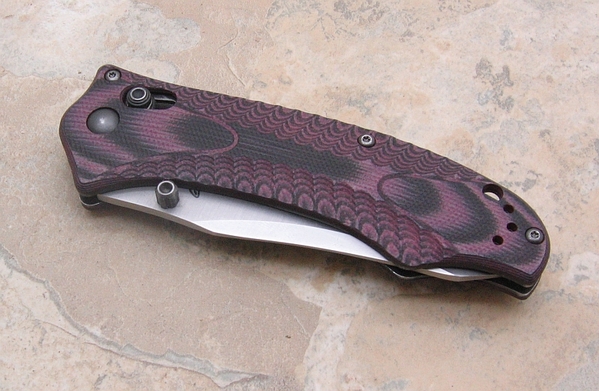
Cherry red ends up being the maroon color of the first Rift.
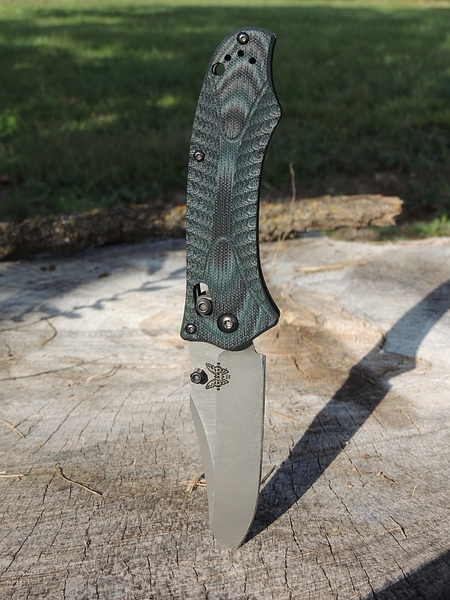
Kelly Green is the 2nd picture.
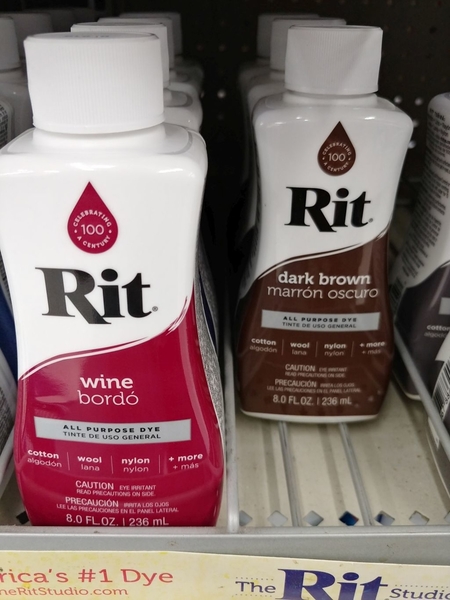
The Wine would end up being closer to a dark maroon unless I add something to counteract the cooler hue of the grey part of the scales. Maybe some of the brown with either the Cherry Red or the Wine?
The purple would be a bluer, darker purple once done.
I read someone's post on FB who used some white vinegar and a couple days soaking to lighten their gray/black scales before dying, so I might try that to get the light gray a little bit lighter. That will help reduce the effect the underlying color will have on my final result. If it works. The G10 Benchmade uses is pretty dense.
My Ti standoffs will end up either raw, bronze, purple, or gold, depending on what color I go with for the scales. Decisions, decisions! Help me out here, folks!
Attachments

-

Hey Loonybin! I just bleached a set of Adamas scales to get them down to the point where the dye would take good and to keep the color from being so dark. This way I had better control of my color when it came to dying them.
To bleach them I boiled them in a mixture of Rit Color Remover, Bleach, Vinegar and Acetone. When I say boiled it was just under a boil, kind of rolling small bubbles. Make sure to mix everything together off of the stove and heat it up mixed as if you add things like Acetone to boiling water the reaction is crazy! My concoction was 1 container of Rit Color Remover, 1/2 cup of Bleach, 1/2 cup of Vinegar and about 1/4 cup of Acetone. I let the scales low boil for about 2 hours adding water as the mixture evaporated. They came out an opaque white jade color which in its own right was pretty cool.
To dye them I used Rit Dye More - Peacock Green, Vinegar and Acetone. This concoction was 1/2 container Rit Dye More, 1/2 cup Vinegar and 1/4 cup Acetone. I again low boiled them for about 10 minutes and in that short amount of time the color came out great! And the scales were un-aduterated (didn't shrink or melt) from the boiling process.
I combined it with a Orange dyed back spacer using the same technique. All in All I was pretty pleased with the outcome.
As your 810-1801 Contego scales are mostly grey it shouldn't be too tough to get them bleached and dyed.
If you like light blue Rit Dye More comes in a "Kentucky Sky" it might be pretty sharp with Gold Ti Hardware or even Dark Blue for that matter! Just my two cents there.
I've been thinking about doing something in a Rit Dye More Apricot Orange (What I used on the back spacer).
DISCLAIMER: It ain't my fault if you melt your scales! lol!
 0
0 -

/|\ LB, be safe & have fun.
Suggest sending wife & kids to the movies so no distractions.
Too many cooks spoil the broth- so do your thing!
1 -

Don't know if this will help or not. Lots of good info though.
1 -
 Tim O posted:
Hey Loonybin! I just bleached a set of Adamas scales to get them down to the point where the dye would take good and to keep the color from being so dark. This way I had better control of my color when it came to dying them.
To bleach them I boiled them in a mixture of Rit Color Remover, Bleach, Vinegar and Acetone. When I say boiled it was just under a boil, kind of rolling small bubbles. Make sure to mix everything together off of the stove and heat it up mixed as if you add things like Acetone to boiling water the reaction is crazy! My concoction was 1 container of Rit Color Remover, 1/2 cup of Bleach, 1/2 cup of Vinegar and about 1/4 cup of Acetone. I let the scales low boil for about 2 hours adding water as the mixture evaporated. They came out an opaque white jade color which in its own right was pretty cool.
To dye them I used Rit Dye More - Peacock Green, Vinegar and Acetone. This concoction was 1/2 container Rit Dye More, 1/2 cup Vinegar and 1/4 cup Acetone. I again low boiled them for about 10 minutes and in that short amount of time the color came out great! And the scales were un-aduterated (didn't shrink or melt) from the boiling process.
I combined it with a Orange dyed back spacer using the same technique. All in All I was pretty pleased with the outcome.
As your 810-1801 Contego scales are mostly grey it shouldn't be too tough to get them bleached and dyed.
If you like light blue Rit Dye More comes in a "Kentucky Sky" it might be pretty sharp with Gold Ti Hardware or even Dark Blue for that matter! Just my two cents there.
I've been thinking about doing something in a Rit Dye More Apricot Orange (What I used on the back spacer).
DISCLAIMER: It ain't my fault if you melt your scales! lol!
I am not an expert of dyeing the scale by any way.
I don't see any reason adding acetone to the boil pot.
Acetone will evaporate way early before the solution is at the boiling point and be careful the vapor.
If you soak it in acetone separately before you boil it. Would that serve your purpose?
I usually clean some parts by soak them in an ultrasound tub fill with acetone.
This was try to remove some oil, grease or very fine stuff on the surface in a high vacuum environment.
For knife scale, you probably only need to soak, wash it for couple minutes.
0 -
I was really amazed at how the factory color was set into the scales. I tried a number of things to get it to lighten. First I soaked them for two days in bleach and barely lightened them at all. Then I tried boiling them in Rit Color Remover by itself for about four hours with no change. Next I tried soaking them in straight acetone for an hour and the scrubbing them with a green pad which was kinda working but it appeared it was going to take a lot of effort and time. So I Google dye removal for synthetics and found a few people had used the aforementioned mixture and method to remove color from plastics and decided to give it a try. It actually gave me the best results and also seemed to open the pores in the plastic of the scales so that when I moved to the dye job it took almost no time to get the color I was looking for.
I completely agree that acetone will evaporate quickly and found that adding more to the boil caused an immediate reaction that was pretty crazy. It almost caused a boil over which would have been disasterous had I not been ready to move the boil pot off the heat of the stove.
I might also add that it's probably not a great idea to do this on the kitchen stove. I have a dual electric burner mini stove in my well ventilated shop that I use for things like this project. 👍
0 -
Tim O posted:
Hey Loonybin! I just bleached a set of Adamas scales to get them down to the point where the dye would take good and to keep the color from being so dark. This way I had better control of my color when it came to dying them.
To bleach them I boiled them in a mixture of Rit Color Remover, Bleach, Vinegar and Acetone. When I say boiled it was just under a boil, kind of rolling small bubbles. Make sure to mix everything together off of the stove and heat it up mixed as if you add things like Acetone to boiling water the reaction is crazy! My concoction was 1 container of Rit Color Remover, 1/2 cup of Bleach, 1/2 cup of Vinegar and about 1/4 cup of Acetone. I let the scales low boil for about 2 hours adding water as the mixture evaporated. They came out an opaque white jade color which in its own right was pretty cool.
To dye them I used Rit Dye More - Peacock Green, Vinegar and Acetone. This concoction was 1/2 container Rit Dye More, 1/2 cup Vinegar and 1/4 cup Acetone. I again low boiled them for about 10 minutes and in that short amount of time the color came out great! And the scales were un-aduterated (didn't shrink or melt) from the boiling process.
I combined it with a Orange dyed back spacer using the same technique. All in All I was pretty pleased with the outcome.
As your 810-1801 Contego scales are mostly grey it shouldn't be too tough to get them bleached and dyed.
If you like light blue Rit Dye More comes in a "Kentucky Sky" it might be pretty sharp with Gold Ti Hardware or even Dark Blue for that matter! Just my two cents there.
I've been thinking about doing something in a Rit Dye More Apricot Orange (What I used on the back spacer).
DISCLAIMER: It ain't my fault if you melt your scales! lol!
Well, mine is a 810-1401, so blue isn't on the table (trying some other color with the -1801 scales).
I use vinegar with the water when dying scales, but what's the purpose of the acetone?
My other concern is that the Adamas scales are monochromatic, but the -1801 scales are two-tone, and I want them to stay that way. Instead of gray/black, I want color/black. I'm concerned that bleaching them will remove the black as well.
0 -
The articles mentioned that acetone opens the pores in synthetics allowing existing color to be extricated and when new dye is applied it allows the dye to be set deeper in the material. As most plastics are very impervious to water based dyes it seemed to make sense that the color would be more resilient and would wear better.
0 -
mrwinks posted:
Don't know if this will help or not. Lots of good info though.
Thanks for that link! It helps give me somewhat of an idea. The difference is that the Sand colored PMAGS are a warm color, while the grey/black scales are a cool color. The bluish hue of the grey affects the color more than the sand color does, so my colors wouldn't turn out quite like those, but it's helpful to get some idea, especially if I can lighten my gray a bit. The "Flame" might end up closest to a true Red by the time the underlying grey affects the final color.
Tim O posted:I was really amazed at how the factory color was set into the scales. I tried a number of things to get it to lighten. First I soaked them for two days in bleach and barely lightened them at all. Then I tried boiling them in Rit Color Remover by itself for about four hours with no change. Next I tried soaking them in straight acetone for an hour and the scrubbing them with a green pad which was kinda working but it appeared it was going to take a lot of effort and time. So I Google dye removal for synthetics and found a few people had used the aforementioned mixture and method to remove color from plastics and decided to give it a try. It actually gave me the best results and also seemed to open the pores in the plastic of the scales so that when I moved to the dye job it took almost no time to get the color I was looking for.
I completely agree that acetone will evaporate quickly and found that adding more to the boil caused an immediate reaction that was pretty crazy. It almost caused a boil over which would have been disasterous had I not been ready to move the boil pot off the heat of the stove.
I might also add that it's probably not a great idea to do this on the kitchen stove. I have a dual electric burner mini stove in my well ventilated shop that I use for things like this project. 👍
Even heating the G10 up to 130º before the acetone boils off might help open the G10 to let the bleach & vinegar do their job. I will give it a try. I just don't want to lose the black from the scales, so I may not bleach it for very long. The one drawback to using the Dye More for synthetics is that their color selection is limited.
1 -
Solution! Make scales out of Sand colored PMAGS!
But seriously, given G10's base components and how they are colored, altering them is probably very difficult.
0 -
This maybe part of the problem
"A material made by inserting woven glass fiber impregnated with epoxy resin binder through a laminate, G-10 is widely used in electronics and printed circuit boards because it is not electrically conductive. It doesn't shrink and holds forms very well ensuring dimensional stability. It does not absorb water."
1 -
mrwinks posted:
This maybe part of the problem
"A material made by inserting woven glass fiber impregnated with epoxy resin binder through a laminate, G-10 is widely used in electronics and printed circuit boards because it is not electrically conductive. It doesn't shrink and holds forms very well ensuring dimensional stability. It does not absorb water."
Yep. I think that's why the articles I read suggested using acetone in the color removal and coloring broths!
 0
0 -
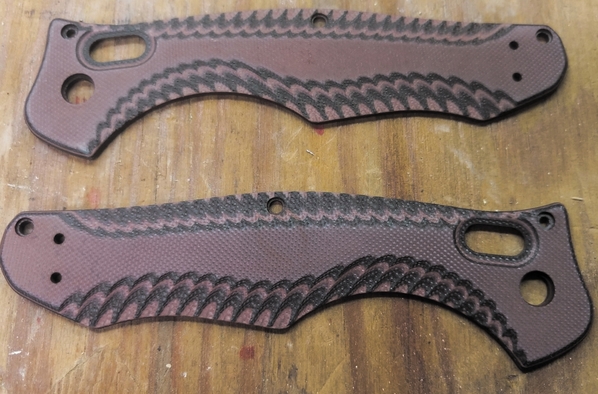
Well, after contacting RIT, their suggestion didn't work. Looking at a color wheel, I needed to add some yellow-orange or orange-yellow to my red to counteract the blue hue of the scales. The results were less than stellar when using Scarlet. It came out an... interesting... shade of brown.
Tim O posted:Hey Loonybin! I just bleached a set of Adamas scales to get them down to the point where the dye would take good and to keep the color from being so dark. This way I had better control of my color when it came to dying them.
To bleach them I boiled them in a mixture of Rit Color Remover, Bleach, Vinegar and Acetone. When I say boiled it was just under a boil, kind of rolling small bubbles. Make sure to mix everything together off of the stove and heat it up mixed as if you add things like Acetone to boiling water the reaction is crazy! My concoction was 1 container of Rit Color Remover, 1/2 cup of Bleach, 1/2 cup of Vinegar and about 1/4 cup of Acetone. I let the scales low boil for about 2 hours adding water as the mixture evaporated. They came out an opaque white jade color which in its own right was pretty cool.
Let me get this straight: you mixed chlorine bleach with acetone?! I hope your area was very well ventilated, as that can make some nasty chlorinated organic compunds and potentially release chlorine gas! Just mixing sodium hyperchlorite (bleach) with sodium hydrosulfite (RIT color remover) can make for a vigorous exothermic reaction!
Attachments
 1
1 -
Yes of course I use an extremely well ventilated area and a dual electric burner with a large enough pot to prevent boil over. And yes the exothermic reaction of sodium hyperchlorite, sodium hydrosulfite and acetone was wild. 🤭
0 -
I'm going to try the color remover and acetone without the bleach on our back porch, so we'll see how it goes.
0 -
The back porch is a great idea if you don't have another well ventilated area.
I'll add that dark colors are a PIA! I tried using the broth mentioned above on some all Black G10 scales and it only lightened the upper layers. I noticed that I was able to see the "fibers" in the G10, but underlying layers were still black. I ended up doing a powder coat on them which came out pretty sweet.
I'm tempted to try going back to the old way of bleaching color and using a combination of sodium hyperchlorite and the sun.
Good luck and let us know how things turn out.
 0
0 -
Well, the brown is gone and it's back to normal, but even after two hours it didn't lighten the gray one bit. I even added bleach after it cooled down and tried again with no change. I guess I will have to decude between maroon scales or purple scales. II haven't tried purple yet and with some brass/bronze/gold anodized standoffs, it could look really cool.
0 -
Stubborn gray!

Purple with brass/bronze/gold hardware ought to look pretty cool if the purple comes out purple Loony!
0 -
Since I know the color remover will bring the scales back to normal, I'm going to try their next suggestion of Dye More dyes: 1 bottle Super Pink, 1/2 bottle Racing Red to see how that goes. If it's just maroon, then I'll remove it and go with the Royal Purple and anodize the screws and standoffs gold (dang, and I just dumped my electrolyte solution and put stuff away!).
0 -
I think this is going to turn out purple-ish, not red. We'll see in an hour or so...
0 -
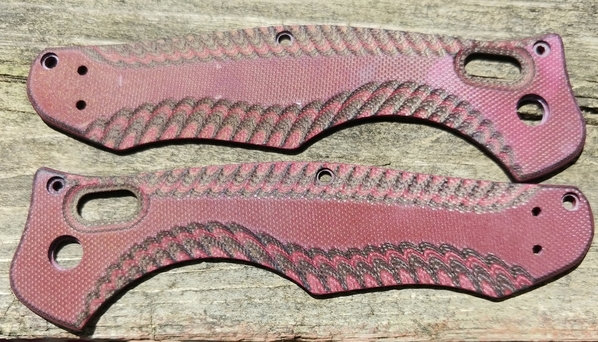
Well, the color isn't bad at all. I can handle a brick red. I didn't clean them good enough, apparently, so I will bleach them, clean them extra good, and go for it again.
Attachments
 0
0 -
Once your dye job is complete are you going to add anything to deepen the color?
0 -
Pic please. Thanks!😀
0 -
Tim O posted:
Once your dye job is complete are you going to add anything to deepen the color?
This is the deeper color. I took this picture in full sunlight. Inside under 4000K fluorescent lights, it looks more purple and considerably darker.
0 -
/|\ LB where is pic?😈
0 -
It took over two hours of simmering to get the Dye More color out, and that was with the color remover, bleach, and acetone! The regular RIT took only 30 minutes or so. By the time I had them bleached, a storm came in, so I couldn't get a picture in the full sun. It only took 15 minutes to dye them, and I think I could have gone less.
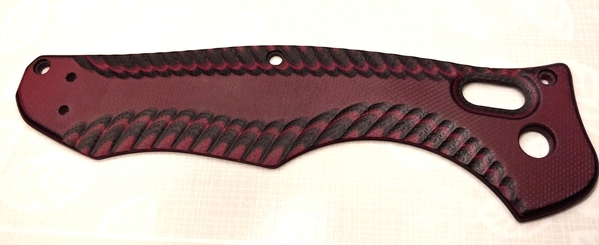
So the moral of the story is to use the RIT Dye More dyes for a fast dye job, but make sure you get it right the first time because it will take forever to get the color out.
1 -
/|\ Thanks LB for sharing.
They look nice
0 -
Thanks! This was directly under my nightstand lamp, so it was bright enough. Without the bright light, it is quite a bit darker and more purple-ish. Hopefully on Tuesday I can get the standoffs and screws anodized.
0 -
I think they came out pretty sweet there Loony! They definitely came out dark enough and the uniformity of the color looks perfect.
I've been using either the Tung Oil to seal them up after (A couple light coats so as not to get a shiny finish) or a light coating of mineral oil just to protect them and bring the G10 grain out.
I've got something coming in that I'll be processing in the broth to get the color out and I'm thinking of using the Rit Dye More "Royal Purple or Apricot Orange" on. Might be removing color more than once if I don't like the results. More to come on that project later.

Show us what it looks like once you get the standoffs and screws anodized, and it's back together!
0 -
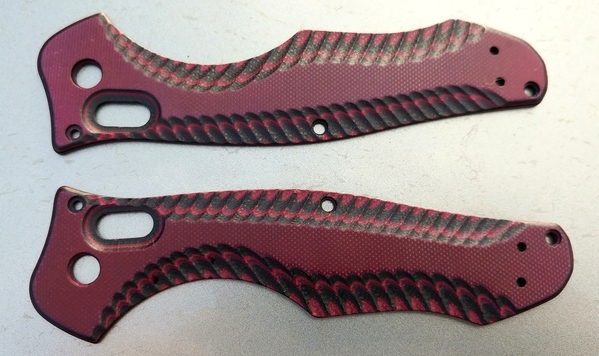
Ok, here's a better picture I managed to get outside tonight during the few minutes of sun we had in between the rain clouds.
 2
2 -

Nice job
1
Please sign in to leave a comment.
Comments
49 comments