Stropping Paste ??

What do you use with your leather strop ????
What brand .......etc.
I dont strop , but Iam gonna start and havent paid attention to past post on the subject ...... so Iam asking again.
Any info is good ............
What brand .......etc.
I dont strop , but Iam gonna start and havent paid attention to past post on the subject ...... so Iam asking again.
Any info is good ............
0
-

I don't actually use a paste. Mine is a brick of chrome buffing compound that I rub on the strop. It works.
I was given the idea about 5 years ago from someone posting on the Benchmade Forum...sorry, I can't remember who got me onto it.0 -
That was my question ....... what do you use on your strop.
Iam sure that some are better than others .....
I just wanted a bunch of opinions.0 -

My understanding is there are different grits, designated by color.
I just stick with green as I don't want a 4 sided strop and I like to finish up on the "clean" side of the strop.
I'm not sure of brands, the stuff I buy just comes in a little Baggie off eBay. My strop, however, is made by Boker.
I would love a Benchmade strop embossed with the butterfly. That would be awesome. Jason, are you listening? Lol0 -

I use untreated (not covered with dye) leather that is glued on wooden paddle.
I use buffing compound. Green Chromium one and red iron oxide one.
I have read somewhere some people use diamond powder compound, but not quite sure where is was or what it was. I'm certain it would improve polish on hard steels like S110V, S90V. Heck even good on M390 or S30V.0 -

I use an old genuine leather belt on a hard-backed surface and load the strop with Flitz (which is a very fine grit compound). Always works like a charm 
I just touched up my 531-131 today (Before/After pics below):
Before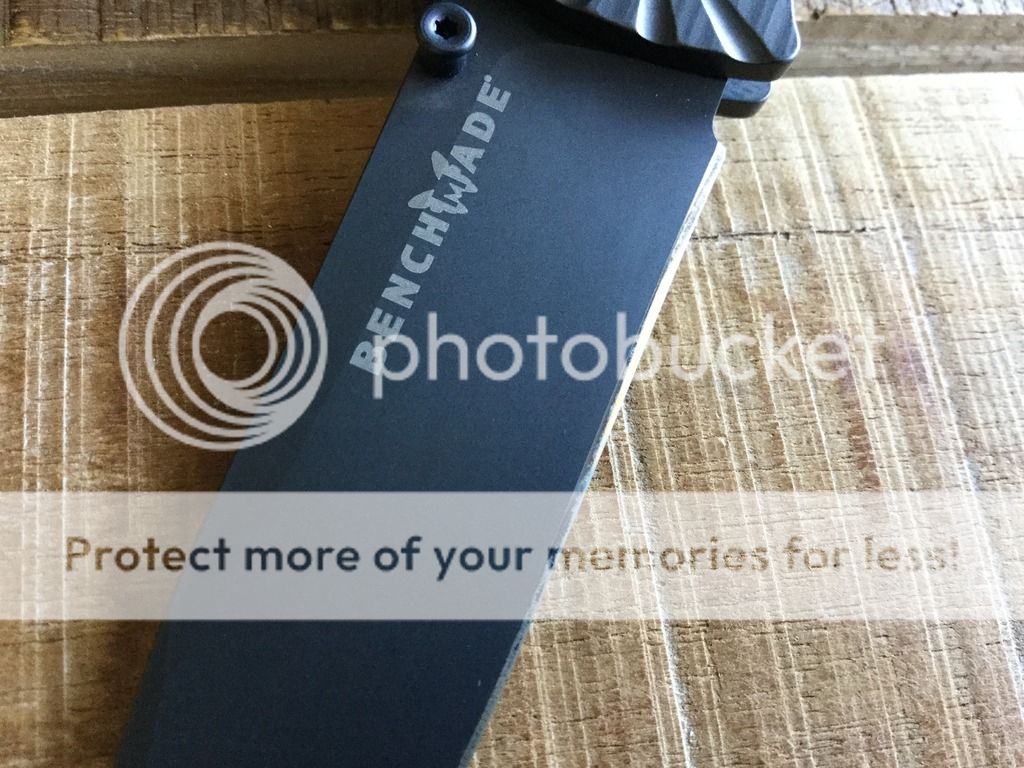
After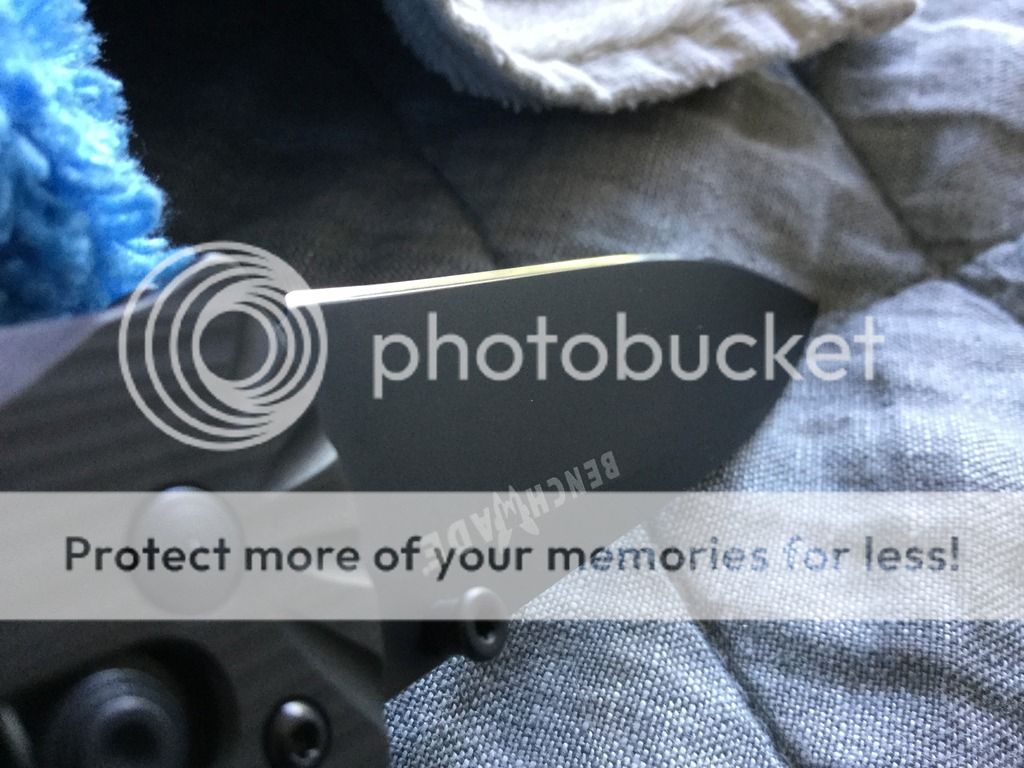
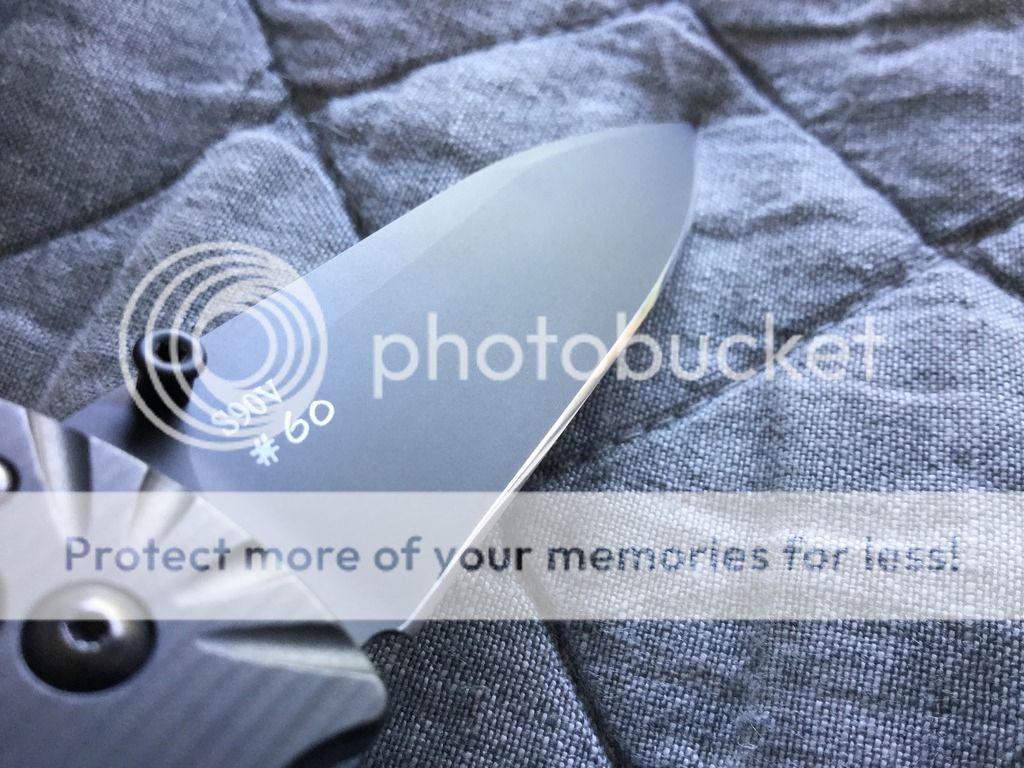
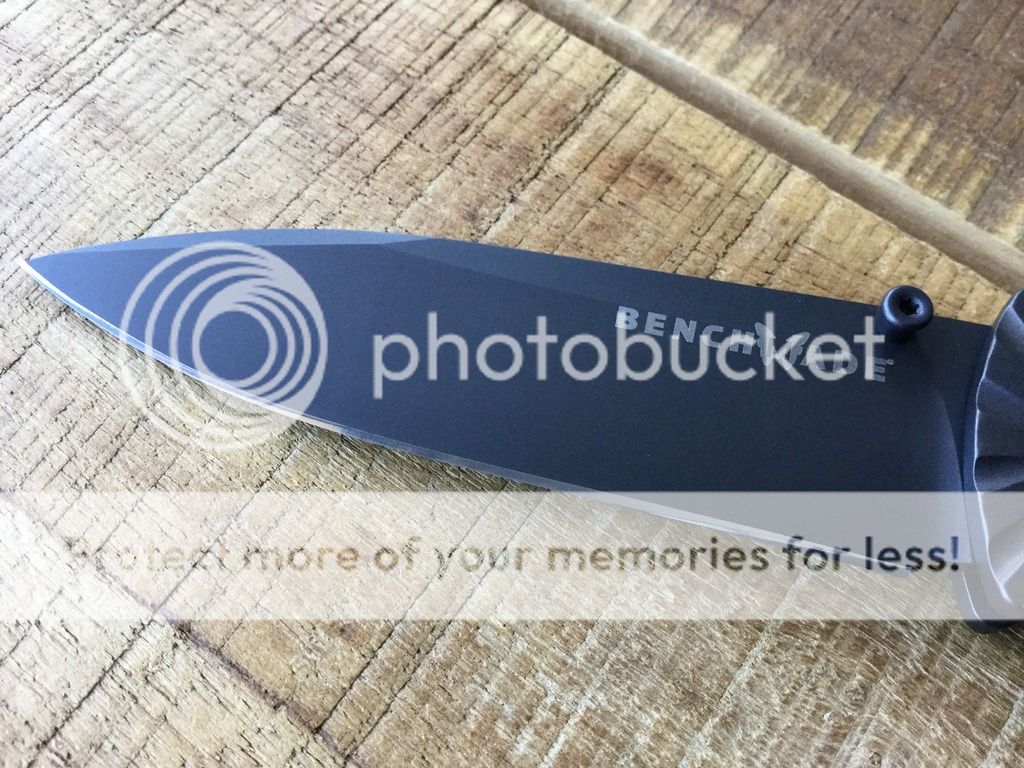 0
0 -
Oh, it must be fun to do stropping with S90V I used diamond compound for those high vanadium boys. 0
0 -
quote:Originally posted by Mobile Firelord:
Oh, it must be fun to do stropping with S90VI used diamond compound for those high vanadium boys.
Flitz worked really well.. Especially if that's all you had laying around the house.. There's a ton of threads over on Blade Forums on Flitz. It's a finer abrasive but will eventually get the job done, especially if all your after is a touch-up & polish..
Here's one for example:
Flitz, Ok for a strop?0 -
 quote:Originally posted by Painstakingly Meticulous:
I...load the strop with Flitz (which is a very fine grit compound). Always works like a charm
Ha! I do the same thing from time to time, but I was afraid if I said so, people would make fun of me.
I think the whole sharpening issue gets awfully over complicated, personally.
Is all green compound the same grit? White? Black?
Sorry, dj, I'm not being much help. I'd start out by doing a search on youtube. Seems like a lot of people in the woodcraft community like the Bark River Knife and Tool compounds. I think the black is 3,000 grit, green is 6,000, and white is 12,000. Up to now, age 58, I've never sharpened an edge finer than 1,000, but maybe I aught to give it a try too, who knows, mebbe I'm missing something. Let me know how it works out for ya.0 -
quote:Originally posted by Po:
Ha! I do the same thing from time to time, but I was afraid if I said so, people would make fun of me.
Really? All it is, is another polishing compound.. Apparently, people have been using it for years on their knives.. Just browse different knife forums online.. There's numerous threads with people who load their strops with it.
One member over on BF contacted a rep from FLITZ and was told that the average grit size was between 3-3.5 microns.. (similar to the white compound)
Post #12quote:Originally posted by Po:
I think the whole sharpening issue gets awfully over complicated, personally.
Agreed.. You can either go full-bore with all the gadgets (e.g., Lanky Polished Edge Tutorial), or you can DIY with home-made strops.. lol I used an old leather belt on a hard-backed surface with FLITZ and got a nice mirrored result..
I'm thinking about adding the strop and polishing accessories to my Lansky though.. I'm also eagerly awaiting my next strop session because I want to try using blue jeans with either FLITZ or another polishing compound (most likely green)..quote:Originally posted by Po:
Is all green compound the same grit? White? Black?
There are numerous Black, White, Green, & Red polishing compound brands that vary in grit size.. Check out Post #2 for a general idea of the grit sizes for the color variations..0 -

I use a four sided strop block that has a handle, this way you have four surfaces for black, green, red, and plain leather for the final polish.
The best part about stropping is a few passes on each side of the edge, on each of the coumpounds, and with regular light edc you can maintain a hair shaving edge indefinitely. If I put a blade to hard use and its really dull, getting a fine edge by hand with only a strop is next to impossible. For that I drag out the ken onion worksharp.0 -

Po, how did you come up with the cardboard strop? I have some brasso that I use to take scratches out of hard plastic. Anyone use brasso for stropping paste? 0 -
I just figured that if cardboard could make an edge dull so efficiently when you cut it, it should make an edge sharp if you strop with it.
Any metal polish would probably work.0 -
Po, you are wise and resourceful. I thought recalcitrant was a typo at first. 0 -
quote:Originally posted by Po:
I just figured that if cardboard could make an edge dull so efficiently when you cut it, it should make an edge sharp if you strop with it.
Any metal polish would probably work.
Yeah, forgot to thank you on this idea few years back!
Thanks, Po.0 -
There are a ton of household materials you could use as a strop.. Just to name a few: - Newspaper
- Magazines
- Cardboard
- Jeans
- Canvas fabric
- Linen shirt
0 - Newspaper
-
 quote:Originally posted by boinkman:
Po, how did you come up with the cardboard strop? I have some brasso that I use to take scratches out of hard plastic. Anyone use brasso for stropping paste?
The cardboard back of a notepad (dense cardboard) works very, very well for a strop.
I'm not sure if Brasso is agressive enough for some steels. For 1095 and the like it might be, but for things like D2, and the super steels, I don't know. I intend on trying some Mother's Mag polish pretty soon.0 -
quote:Originally posted by loonybin:
I'm not sure if Brasso is agressive enough for some steels.
Agreed. Especially on the more modern steels. Search BF, there's a lot of similar claims of people having a hard time with Brasso.0 -
quote:Originally posted by Painstakingly Meticulous:quote:Originally posted by loonybin:
I'm not sure if Brasso is agressive enough for some steels.
Agreed. Especially on the more modern steels. Search BF, there's a lot of similar claims of people having a hard time with Brasso.
Here is the ingredients.
The label of Australian Brasso lists "Liquid Hydrocarbons 630g/L; Ammonia 5g/L", whereas the Material Safety Data Sheet for Brasso in North America lists: isopropyl alcohol 3-5%, ammonia 5-10%, silica powder 15-20% and oxalic acid 0-3% as the ingredients.[2] However, the Australian version contains kaolin and quartz instead of silica for abrasives
So it is no different than some of the stropping paste. (Aluminum oxide (Rogue), Chromium oxide (green/black), and Silicon oxide(White))
It doesn't seems to say how fine they are.0 -
quote:Originally posted by Mobile Firelord:quote:Originally posted by Painstakingly Meticulous:quote:Originally posted by loonybin:
I'm not sure if Brasso is agressive enough for some steels.
Agreed. Especially on the more modern steels. Search BF, there's a lot of similar claims of people having a hard time with Brasso.
Here is the ingredients.
The label of Australian Brasso lists "Liquid Hydrocarbons 630g/L; Ammonia 5g/L", whereas the Material Safety Data Sheet for Brasso in North America lists: isopropyl alcohol 3-5%, ammonia 5-10%, silica powder 15-20% and oxalic acid 0-3% as the ingredients.[2] However, the Australian version contains kaolin and quartz instead of silica for abrasives
So it is no different than some of the stropping paste. (Aluminum oxide (Rogue), Chromium oxide (green/black), and Silicon oxide(White))
It doesn't seems to say how fine they are.
That silica powder in Brasso won't do much at all (if anything) on the harder alloy steels. It's softer than the aluminum oxide or chromium oxide, and is different from silicon oxide enough that I question it's effectiveness.0 -

The old color compounds don't have hard enough particles to shape the harder carbides[some nitrides and borides too] formed by tungsten, vanadium, tantalum, and titanium alloys. The diamond and cubic boron nitride compounds are sold as sprays and emulsions by a few places(Ken Shwartz and jende come to mind) Now whether or not you need to cut the carbides depends on the size of the carbides(looking at you D2) and the fineness of the edge you are seeking(razors, sushi knives), abrading the iron matrix is fine if your edge will be honed rougher than the carbides in it.
On finer edges(both in angle and polish) you can either shape the carbides or tear them out. Paper/carboard is fine for some[most] edges but may be too coarse for edges that whittle free floating hairs under a microscope, also cardboard is often partly recycled and has lots of debris in it. For the finest compounds, folks seem to like a hard smooth leather, horse is popular[the feel/feedback maybe], bovine is fine(and cheaper), kangaroo is super fine(and very strong) then some are selling and swearing by some wizardry labeled as nanocloth.(meant to hold compounds and have no abrasive or stropping effect of its own.)
Secondly and something often overlooked is that grit sizing systems are all over the map 3000 is not 3000 is not 3000; new jis[japan], ansi[USA] bonded, ansi coated, euro P(coated) and F(bonded), and straight spec'd micron mean with tolerances. I see a move in enthusiast sharpening toward micron spec as a standard(but often the tolerance is overlooked, oversized outliers can ruin the day) so 1000ansi bonded is more like 2-3k in new jis wetstones. And of course you have bonded abrasive bond strength, stated as a letter grade on industrial products [eg J or K is used for common grey grinding wheels]
Anyway back to strop compounds. I have seen diamond down to 0.01 micron, and 0.1 is not uncommon in actual use, cBN can be had at least to 0.1. As I recall 1.0 micron is still in the common stone range around 5k jis. cBN is claimed to hold up longer but I haven't confirmed it, but diamond does have more fracture planes and at several hundred degrees Celsius diamond both softens more than cBN and dissolves in iron, cbn likes oil as lube[neat, not emulsions].0 -

My strop is cardboard and the past I use is Mothers mag wheel polish, works great. 0
Please sign in to leave a comment.
Comments
21 comments